How NHS Budgets Support Solar Panels
The NHS is one of the single largest consumers of energy in the UK public sector. Running hospital campuses, specialist units, and primary care centres requires continuous, heavy power, from heating operating theatres to powering life-saving diagnostic machinery.

With energy bills spiking since 2019 and total NHS utility costs reaching £1.4 billion annually, managing utility expenses has become a critical financial challenge (BBC News, 2026; Department for Energy Security & Net Zero, 2026).
Commercial solar photovoltaic (PV) generation offers a strategic, self-sustaining financial solution. By converting unused roof space, car parks, and brownfield land into clean energy stations, NHS Trusts can reduce their reliance on expensive grid power and protect their operational budgets against energy market volatility.
The Financial Strain of 24/7 Operational Demands
Major acute hospitals operate 24 hours a day, 365 days a year. HVAC systems, intensive care units, MRI scanners, and sterilisation suites demand constant, round-the-clock power. Primary care facilities and outpatient clinics experience heavy daytime energy usage, aligning with peak solar output.
When energy tariffs fluctuate unpredictably, Trusts must divert operational capital just to pay utility bills. Every pound spent on inflated electricity invoices is a pound unavailable for clinical staffing, medical equipment upgrades, or reducing treatment backlogs.
Solar PV systems address this challenge by providing predictable, low-cost electricity at a fixed rate per kilowatt-hour over a 25– to 30-year operational lifespan, delivering long-term budget stability for healthcare finance directors.
Financing Models & Economic Structure
NHS Trusts can fund and deploy solar installations through several flexible financial routes tailored to public sector budget constraints:
Capital Expenditure (CapEx) & Direct Purchase: Trusts with access to internal capital or capital grants fund the installation outright. This offers the lowest lifetime cost per kWh and the maximum long-term financial yield, achieving capital payback in as little as 3 to 6 years.
Click here to learn more.
Power Purchase Agreements (PPAs): A zero-capital route where a third-party funder designs, finances, installs, and maintains the solar system. The NHS Trust signs a long-term agreement (typically 15 to 25 years) to buy the generated power at an agreed index-linked rate, often 11–15 p/kWh, compared to grid rates of 28–32 p/kWh. This delivers immediate operational savings without impacting capital budgets.
Click here to learn more.
Private Wire PPAs: Designed for large acute hospital sites or multi-facility campuses where solar panels (or ground-mounted arrays on nearby land) are linked directly to the hospital’s internal distribution network via a dedicated cable (private wire). This completely bypasses National Grid transmission and distribution charges, maximising savings per kWh.
Click here to learn more.
Public Sector Decarbonisation Schemes & Grants: Central government grants offer non-repayable capital to lower the net cost of renewables, making CapEx payback periods even faster.
Click here to learn more.
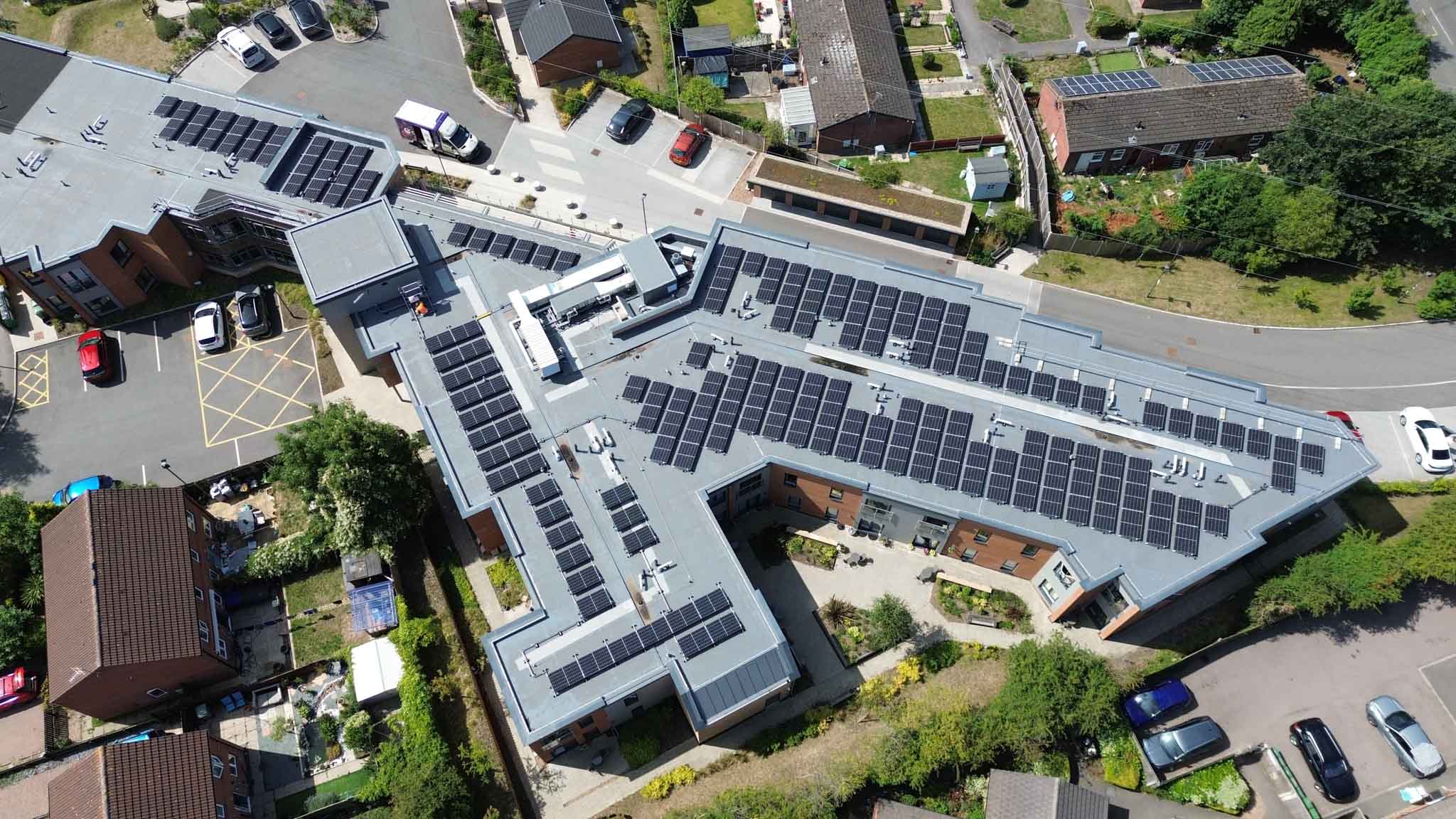
Central Funding: The Great British Energy Expansion
Public sector clean energy initiatives are providing dedicated capital funding to accelerate solar adoption across healthcare estates.
Great British Energy: NHS Solar Initiative
Total Public Sector Funding: Up to £255 Million
Dedicated NHS Capital Funding: £100 Million
Scope of Healthcare Sites: 260 NHS Sites (across 34+ Trusts)
Average Annual Site Savings: Up to £45,000 per year per site
Total Lifetime Savings: Up to £325 million for the NHS
(UK Government, 2025).
The UK Government and Great British Energy have expanded overall clean energy investment to £255 million across schools, military sites, and health facilities. Within this, £100 million in capital funding is dedicated to NHS Trusts to install rooftop PV and battery storage systems across approximately 260 sites.
This national programme provides crucial capital support so Trusts can secure immediate bill reductions without placing additional pressure on local healthcare budgets.
Key Pillars of Financial Value
Direct Utility Reduction: High daytime self-consumption means almost every unit of solar power displaces retail grid electricity.
Battery Energy Storage (BESS): Captures peak daytime solar generation for deployment during high-tariff evening hours, reducing peak grid charges and improving site power resilience.
Future EV & Heat Electrification: Provides low-cost electricity to power electric ambulance fleets and low-carbon heat pumps without incurring grid capacity upgrade fees.
Net Zero Compliance: Reduces Scope 1 and Scope 2 emissions directly, helping NHS sites meet national Net Zero targets without costly carbon offset penalties.
Low-Disruption Delivery in Active Clinical Settings
Installing systems in healthcare facilities requires specialised engineering and project delivery. Hospitals must maintain continuous operational flow, strict infection control, and unobstructed emergency access.
Geo Green Power works with NHS Trusts nationwide, managing the entire lifecycle, from feasibility studies, PPA structuring, and DNO grid approvals to installation and Commercial Solar Panel Maintenance.
Projects are scheduled and executed with zero disruption to clinical workflows, ensuring healthcare sites can maximise financial performance while maintaining high standards of patient care.
For Healthcare Solar Solutions, visit our sector page.
And for specific information on how we provide Solar for Hospitals, visit our dedicated page.
Ref:
https://www.bbc.co.uk/news/articles/cqjkl1xvgw5o (BBC News, 2026).
https://www.gov.uk/government/publications/fuel-poverty-strategy-for-england/fuel-poverty-strategy-for-england–2 (Department for Energy Security & Net Zero, 2026).
https://www.gov.uk/government/news/nhs-sites-to-cut-bills-with-great-british-energy-solar-panels (UK Government, 2025).