Harnessing the Sun Across Generations: Retrofitting Historic vs. Modern University Campuses with Solar Energy
Higher education institutions across the UK are standing at a pivotal crossroads. As universities push to achieve ambitious Net Zero targets, campus decarbonisation has evolved from an environmental aspirational goal into an urgent operational priority.
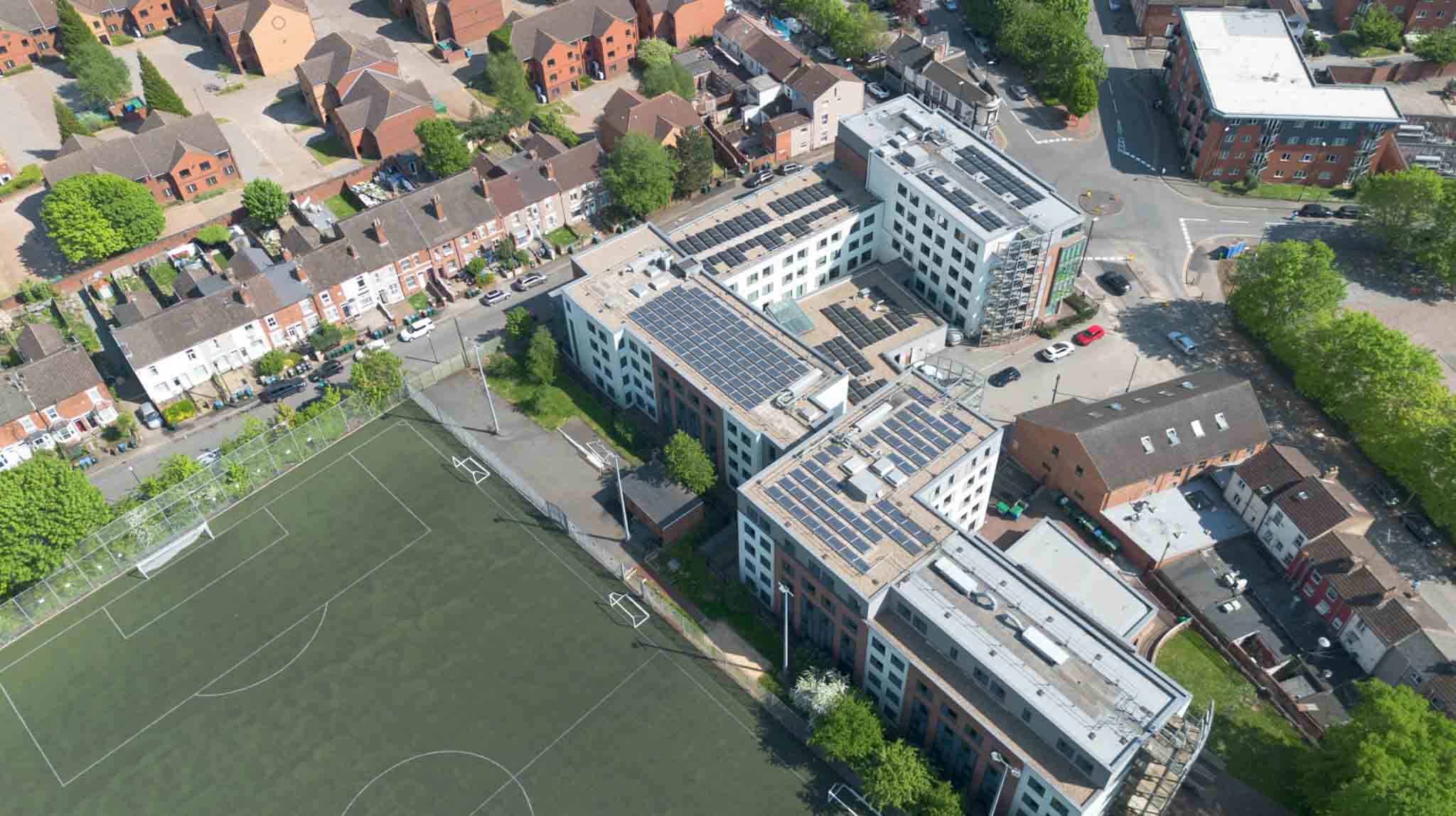
UK university estates present a unique engineering puzzle: they often encompass a mix of multi-century, Grade I or Grade II listed heritage sites alongside ultra-modern, glass-and-steel academic facilities.
Unlocking the potential of solar power requires navigating this architectural diversity. While retrofitting historic rooflines with photovoltaic (PV) systems requires bespoke conservation approaches, equipping contemporary campus structures presents entirely different technical and structural opportunities.
At Geo Green Power, we specialise in delivering tailored renewable energy infrastructure across the commercial and education sectors. From navigating strict heritage guidelines to optimising large-scale commercial arrays, understanding the dual approaches to modern and historic retrofits is essential for any institution seeking a sustainable future.
The Academic Imperative: Bridging Tradition and Clean Energy
The higher education sector has long been an incubator for scientific advancement and social progress. Today, that leadership extends directly to environmental stewardship. Across the country, institutions are turning to solar panel installations to significantly lower baseline energy consumption, buffer against volatile grid energy prices, and demonstrate visible sustainability leadership to prospective students and researchers.
Geo Green Power has a proud track record of supporting higher education institutions on their decarbonisation journeys. Our experience includes delivering complex renewable infrastructure for leading institutions, including successful projects with the University of Nottingham and the University of Westminster.
Our engagement with academia goes beyond technical delivery. Our Managing Director, James Cunningham, frequently contributes to the sector as a guest speaker at the University of Derby, sharing practical insights on commercial renewable strategy and energy resilience. Furthermore, our Chairman (and CEO of our sister hydrogen technology firm, GeoPura), Andrew Cunningham, serves as an Honorary Professor at the University of Nottingham, fostering continuous knowledge-sharing between clean energy innovation and academic research.
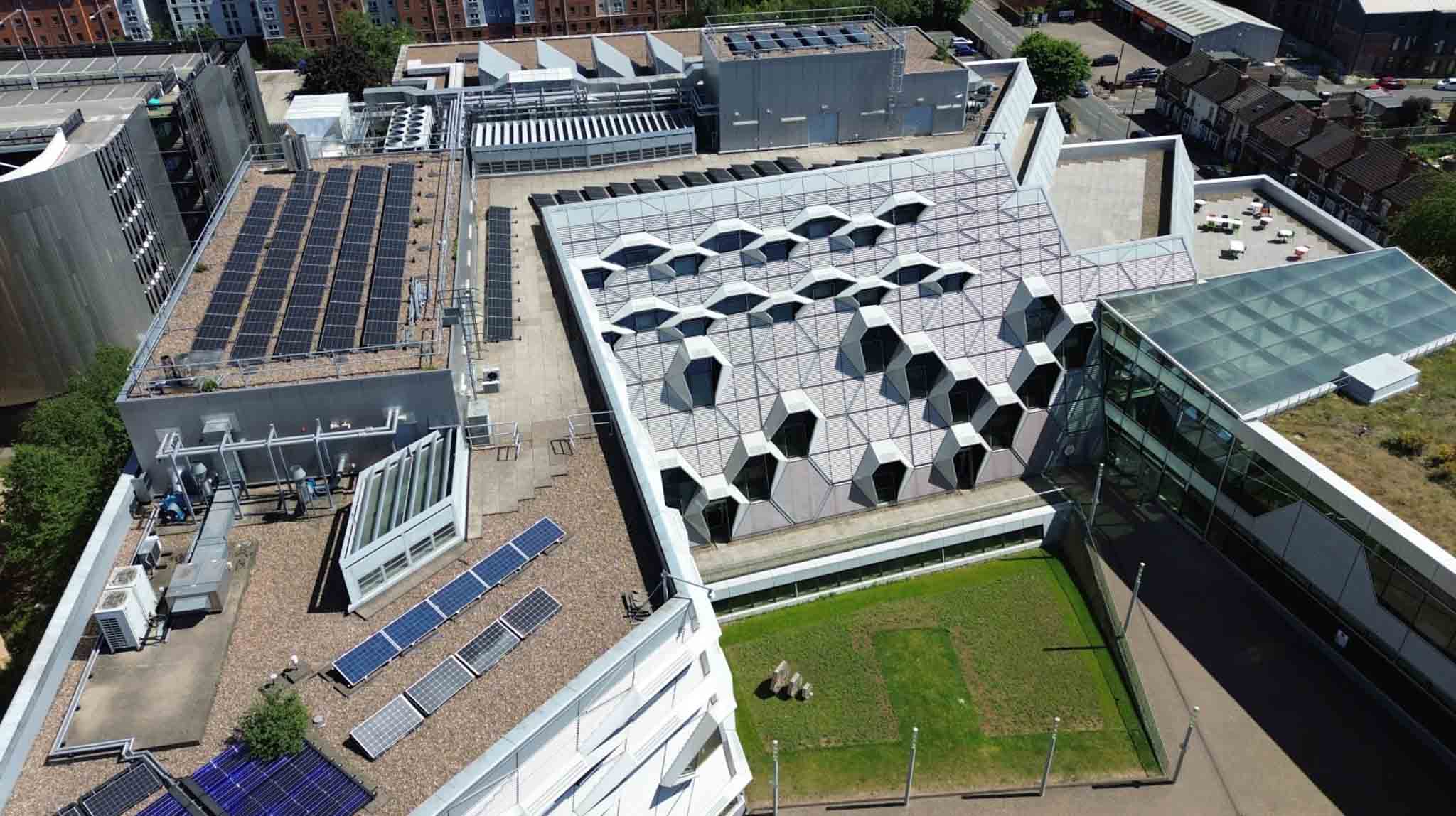
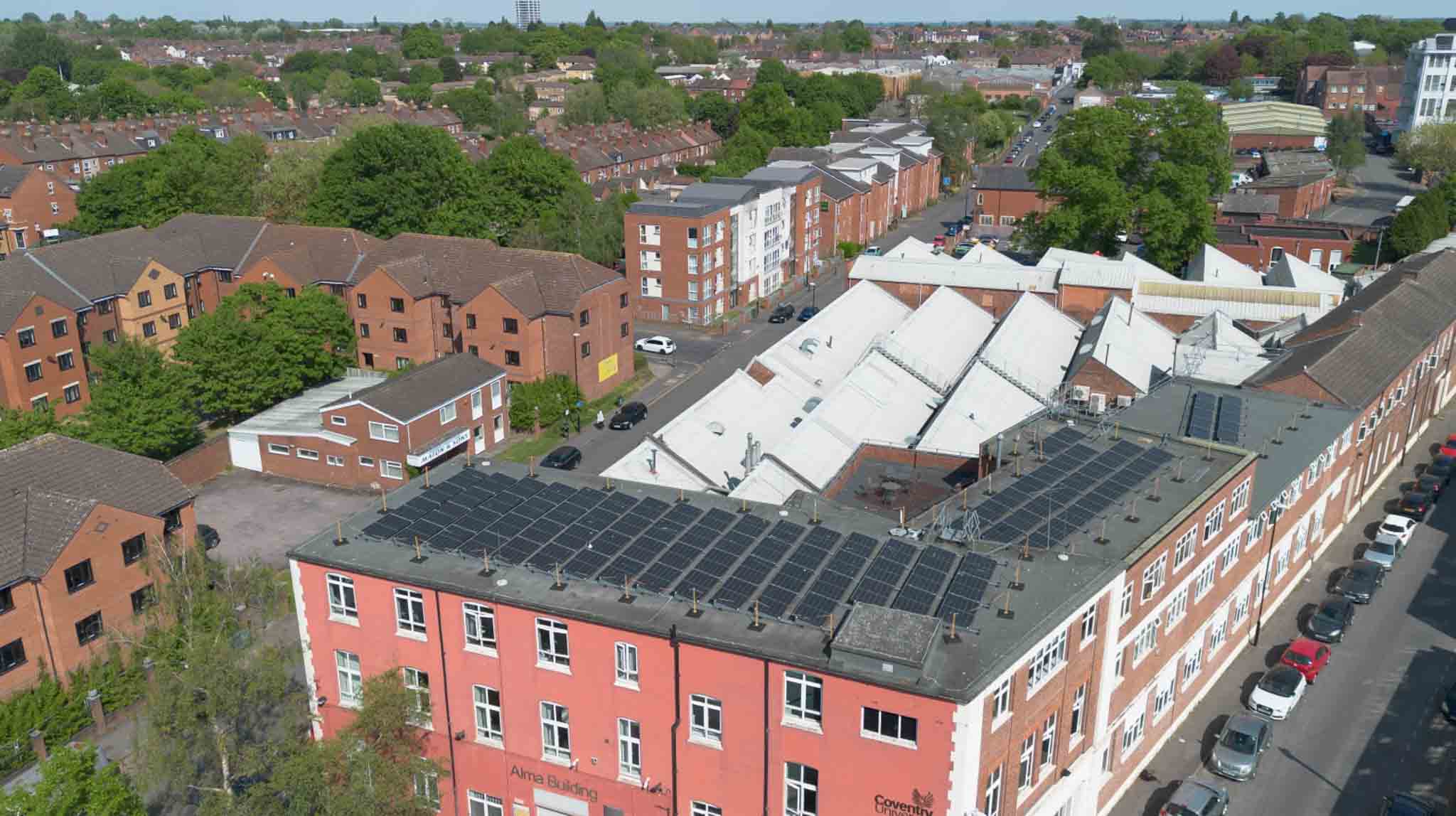
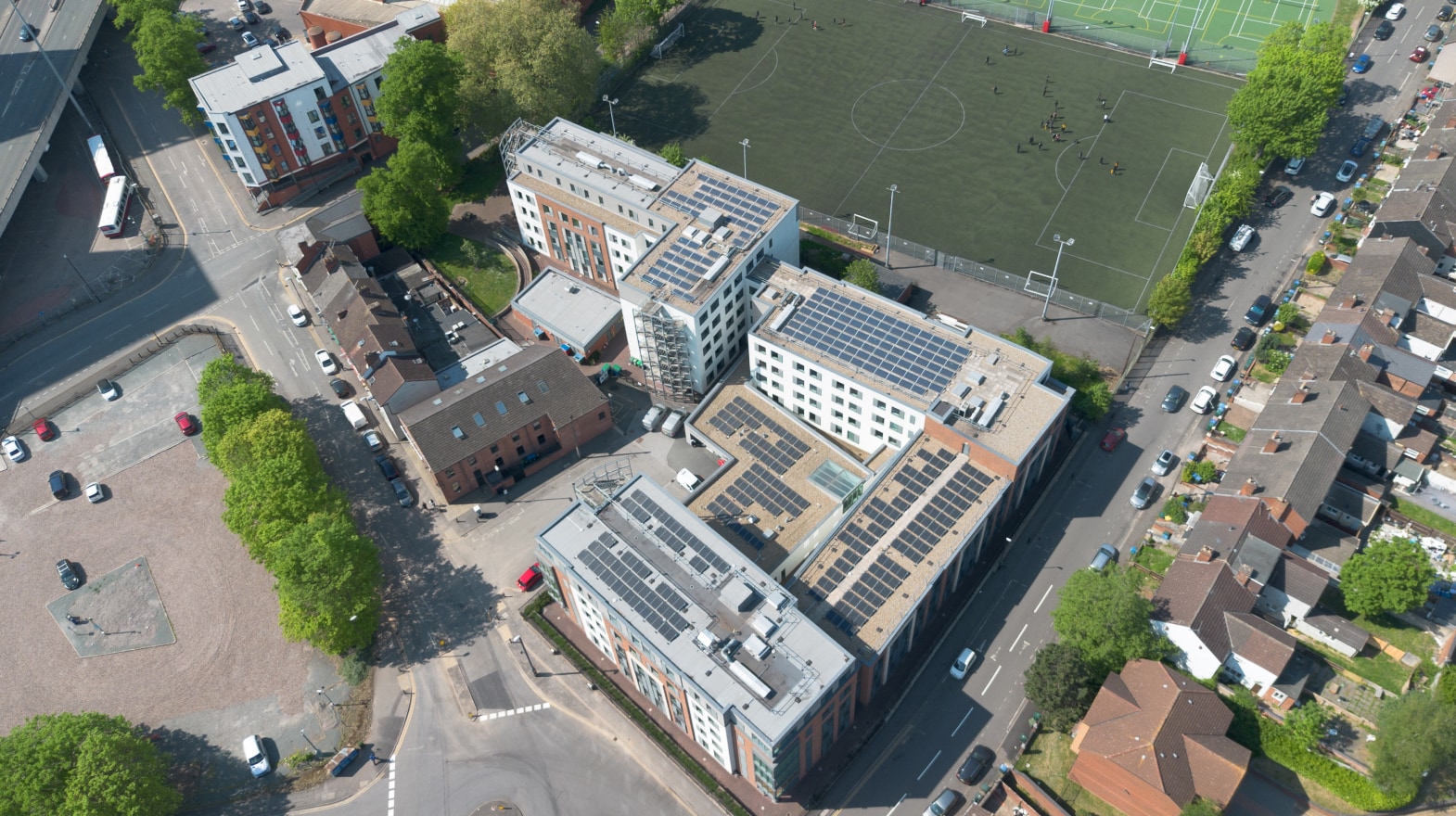
A prime example of this collaborative approach is our work with Coventry University. Tasked with supporting their campus-wide Net Zero strategy, Geo Green Power designed and installed a solar PV system across five distinct university buildings.
Modern vs. Historic: Key Planning and Structural Considerations
When planning campus-wide solar adoption, university facilities teams must adapt their design philosophy based on the age and designation of each building.
Campus Architectural Decision Matrix
| Modern Facilities | Historic Buildings |
|---|---|
| - High Load Capacities - Large Flat Roof Space - Direct BMS Density - Max Enery Density | - Heritage Listing - Slate/Lead Roof - Non-Penetrative Mounts - Sightline Mitigation |
Modern University Infrastructure
Structural Load & Space: Modern campus buildings typically feature spacious flat roofs, steel frame construction, and high structural load capacities. This allows for high-density panel layouts that maximise total output.
Orientation & Efficiency: Mounting systems can be optimised using east-west or south-facing ballasted frames tilted at ideal angles to catch maximum solar irradiance throughout the day.
Smart Integration: Contemporary buildings feature modern Building Management Systems (BMS). Solar inverters can integrate directly into automated microgrids, enabling real-time power tracking, commercial battery storage coupling, and smart load management.
Historic Campus Buildings
Listed Status & Conservation: Historic buildings, often Grade I, Grade II, or situated in designated Conservation Areas, are subject to strict planning regulations. Project approval hinges on preserving historic fabric and avoiding visual harm.
Roof Substrates & Fragility: Unlike concrete or steel roof decks, historic roofs frequently feature hand-cut Welsh slate, timber rafters, or lead cladding. Physical penetration or excessive point-loading can compromise centuries-old roofing materials.
An example of this is Geo Green Power’s ongoing installation work with Drax (which includes A-rated buildings – the most sensitive rating for conservation).
Aesthetic Sensitivity: Conservation officers typically mandate that solar arrays remain invisible from primary pedestrian thoroughfares and historic vistas.
Preserving Heritage Integrity: Engineering Solutions for Historic Roofs
A common misconception is that heritage designation prevents the installation of solar power. With sympathetic engineering, solar arrays can be installed on historic buildings WITHOUT compromising their architectural or physical integrity.
Non-Penetrative and Ballasted Mounting
To protect historic roof membranes, tiles, and slates, engineers utilise non-invasive attachment methods rather than drilling through original materials. For historic flat or low-pitch roofs, weighted, aerodynamic ballasted mounting systems, such as those from VDV, Renusol, or Schletter, allow solar frames to sit securely under their own weight. On pitched slate or Rosemary tile roofs, specialised hardware like Solar Limpets or Solar Slate Plates enables mounting rails to secure safely to internal roof timbers without cracking or damaging the original slates and tiles.
Sightline Planning and Visual Mitigation
Preserving the character of a historic building requires careful spatial positioning. By utilising advanced scanning and drone topography, engineering teams map sightlines from ground level. Solar panels are then strategically positioned behind parapet walls, within hidden roof valleys, or on inward-facing pitch slopes that remain invisible from public vantage points.
Micro-Inverters and Sympathetic Cable Routing
In historic structures, running heavy electrical conduits can risk interior stonework or decorative timber. Utilising micro-inverters, which convert DC power to AC directly behind each panel, allows for smaller, more flexible wiring harness layouts. Electrical paths are routed through disused chimneys, existing service risers, or beneath rainwater goods to ensure zero damage to historic interiors.
Safety Standards and Risk Mitigation
A primary concern for university governing boards when evaluating solar on both historic and modern assets is risk management, specifically structural integrity and fire safety. Modern solar technology is subject to some of the stringent electrical and structural safety standards in commercial construction, keeping risks to buildings virtually negligible when installed by accredited specialists.
Structural Integrity & Wind Loading: Prior to any installation, structural engineers conduct detailed load-bearing calculations and wind-tunnel simulations. On historic timber frames, load tests ensure weight distribution remains far below structural thresholds.
Rapid Shutdown & DC Isolation: Modern commercial solar installations incorporate rapid shutdown technology and automated DC isolators. In the unlikely event of a power fault or emergency, the system instantly de-energises down to module level within milliseconds, eliminating high-voltage risks.
Fire Safety & Thermal Monitoring: Solar components are manufactured from non-combustible materials and installed with localised arc-fault circuit interrupters (AFCI). Integrated micro-inverters provide continuous thermal tracking across individual panels, alerting facilities managers to temperature fluctuations before issues arise.
Weatherproofing & Waterproofing Integrity: Specialised flashing systems and non-destructive flashing boots ensure the weather envelope of the building remains completely sealed, preventing moisture ingress and timber decay.
Driving the Future of Sustainable Higher Education
Decarbonising university estates requires a nuanced, multi-faceted approach. Modern campus buildings offer high-yielding generation platforms that drive bulk carbon reduction, while historic structures demonstrate that even centuries-old heritage assets can participate in the clean energy transition when approached with care and specialised engineering.
By combining rigorous heritage preservation techniques with cutting-edge renewable technology, UK universities can reduce operational overheads, build long-term energy resilience, and set a powerful example for the leaders of tomorrow.
Whether your university estate features contemporary research facilities or Grade-listed heritage architecture, Geo Green Power brings the technical insight and industry experience required to bring your net-zero vision to life.
To discuss a solar retrofit strategy tailored to your university campus, contact the Geo Green Power team today.
If you’re interested in a renewable energy upgrade, visit our dedicated page on Solar Panels for Universities.
For Commercial Solar Maintenance, visit our service page.