Solar for Commercial Landlords vs Tenants: What Rights Does Each Have, and Who Ultimately Wins?
Commercial rooftops across the UK represent millions of square metres of untapped clean energy potential. Yet, unlike owner-occupied warehouses or factories, leased commercial properties come with an extra layer of legal and financial complexity. Because one party owns the bricks and mortar while the other pays the electricity bills, installing solar PV requires careful consideration.
Understanding where each party stands under UK commercial property law, and how flexible commercial agreements can bridge the gap, is the first step toward unlocking a successful solar project without triggering lease disputes or costly delays.
The Core Dilemma: Split Incentives in Commercial Property
In commercial real estate, solar adoption often runs into what energy economists call the “split incentive” problem:
- The Landlord’s Perspective: Property owners control the building envelope and long-term asset value. However, if the tenant pays the utility bills directly, the landlord sees no immediate reduction in operating costs from funding a solar array.
- The Tenant’s Perspective: Occupiers feel the immediate pain of high grid electricity prices and face mounting pressure to meet corporate carbon reduction targets. Yet, investing capital into a building they do not own, especially on a short- or medium-term lease, carries obvious financial risk.
To overcome this divide, both parties must look closely at what their existing occupational lease permits and how legal ownership of the roof is structured.

What Rights Do Commercial Landlords Have?
As the freeholder or superior leaseholder, the landlord holds the ultimate control over the physical structure of the building, subject to the rights already granted to the occupier.
Control Over the Roof and Airspace
In many commercial leases, particularly multi-let industrial estates or office blocks, the “demised premises” (the area rented by the tenant) only covers the internal space.
The landlord retains full legal ownership and control of the structural roof and the airspace above it.
Even in a full repairing and insuring (FRI) lease of a standalone warehouse where the roof is included in the tenant’s demise, the lease almost always restricts structural alterations.
Right of Consent and Veto
Landlords typically have the right to approve or refuse structural changes to the building.
Because mounting solar panels involves adding dead load and wind uplift forces to the roof structure, and potentially penetrating the roof membrane, landlords can insist on:
- Reviewing independent structural engineering surveys before granting permission.
- Requiring a formal Licence for Alterations to document the works and protect the building’s integrity.
- Ensuring the installation does not void existing roofing manufacturer warranties or invalidate the building’s insurance policy.

Future Redevelopment and Access Rights
Landlords have a legitimate interest in ensuring solar equipment does not block future maintenance, re-roofing, or site redevelopment.
If a landlord installs solar themselves on a tenanted building, they must check whether the lease grants them the legal right to enter the premises to install, maintain, and run cabling through the tenant’s space.
What Rights Do Commercial Tenants Have?
While tenants rarely have an automatic right to bolt equipment onto a commercial roof, they possess significant leverage and specific legal protections depending on how their lease is drafted.
Right to Quiet Enjoyment
Every commercial lease includes a covenant for “quiet enjoyment,” meaning the landlord cannot substantially interfere with the tenant’s lawful use and occupation of the property.
A landlord cannot simply erect scaffolding, shut off power to connect inverters, or cause disruptive noise without the tenant’s cooperation and proper notice.
Qualified Covenants Against Alterations
Many modern commercial leases contain a “qualified covenant” regarding alterations, stating that the tenant cannot make changes without the landlord’s consent; such consent not to be unreasonably withheld.
Under the Landlord and Tenant Act 1927, if a tenant proposes an improvement (which can include energy-efficiency upgrades), the landlord must act reasonably and cannot refuse consent purely out of spite or to extract an unfair financial penalty.

Ownership of Trade Fixtures
If a tenant funds and installs a solar PV system with permission, the legal documentation should explicitly classify the panels as the tenant’s fixtures (or chattels) rather than the landlord’s fixtures. This protects the tenant’s right to:
- Claim capital allowances on the equipment expenditure.
- Remove the system at the end of the lease term (provided they make good any damage to the roof)
- Negotiate a sale of the system to the landlord or an incoming tenant upon vacating.
Comparing Landlord vs Tenant Positions
| Key Factor | Commercial Landlord | Commercial Tenant |
|---|---|---|
| Primary Goal | Increase asset value, improve EPC ratings, generate rental/PPA yield. | Cut electricity bills immediately, achieve Scope 2 carbon reductions. |
| Roof Control | High retains freehold and structural oversight. | Limited, restricted by lease demise and alteration of clauses. |
| Capital Allowances | Can claim if funding the system directly. | Can claim if funding and owning the system. |
| Main Risk | Roof damage, void warranties, or stranded assets if a tenant leaves. | Losing unrecovered investment if the lease ends early or a break clause is triggered. |
| Legal Mechanism | Rooftop lease, Private Power Purchase Agreement (PPA), or License for Alterations. | License for Alterations + Lease Variation (or PPA with landlord/developer). |
How Private Power Purchase Agreements (PPAs) Bridge the Gap
One of the most effective ways to resolve the split incentive is an on-site Private Power Purchase Agreement (PPA) directly between the landlord and the tenant.
Rather than relying on a third-party external funder, the landlord acts as the energy investor.
For more information on PPAs, read our dedicated guide.
How a Landlord-Funded PPA Works
Under a private PPA, the landlord funds the upfront capital cost of the solar PV installation and retains ownership of the hardware.
The landlord then sells the clean electricity generated on the roof directly to the tenant via a private wire connection, metered separately from the grid.
- Predictable Discounted Tariffs: A Power Purchase Agreement (PPA) sets a fixed price per kWh for electricity supplied by a provider-owned, on-site solar array. Indicative 2026 rates start at 8p–22p/kWh in year one, undercutting the 22p–25p/kWh medium to extra-large UK businesses pay for grid electricity (Solar Power Purchase Agreements, 2026).
- Index-Linked Long-Term Yield: The PPA tariff is typically linked to inflation (such as CPI or RPI) with a collar-and-cap mechanism. This provides the landlord with a reliable, long-term revenue stream alongside a higher EPC rating and stronger capital valuation.
- Export Fallback: If a unit becomes temporarily vacant or the tenant uses less power on weekends, any surplus electricity is exported to the grid under the Smart Export Guarantee (SEG) or a commercial export tariff, protecting the landlord’s return.
For a more detailed guide on SEG Payments, read our article.
Real-World Example: Litton Properties
A working example of this model in action is Litton Properties, a commercial property developer and landlord.
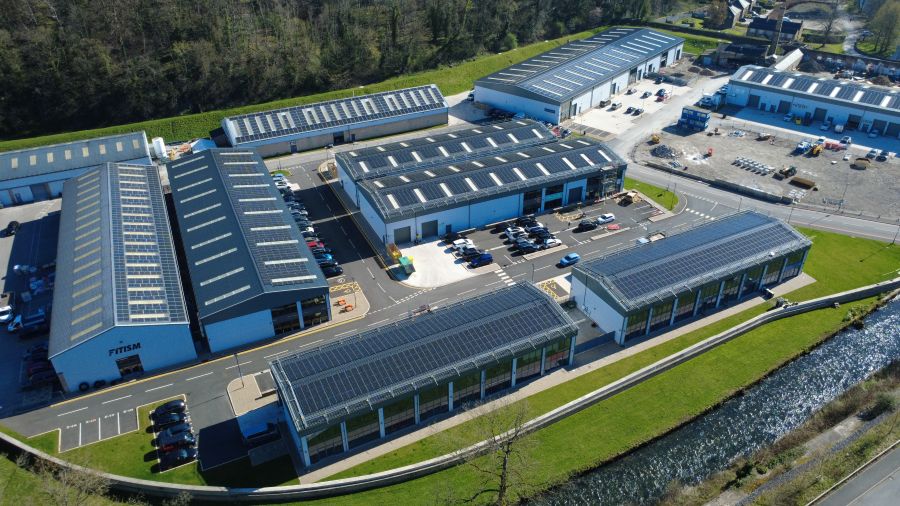
Working with Geo Green Power, Litton Properties rolled out over 1.12MWp of rooftop solar PV across its multi-site commercial business parks.
By self-funding the installations and supplying the generated electricity directly to its occupiers, Litton turned unused roof space into a profitable, yield-generating asset while giving tenants access to lower-cost, low-carbon power, proving that landlords do not need to rely solely on external third-party funders to make commercial solar pay.
Visit our case study page for more information.
Creative Collaboration Models for Landlords and Tenants
Beyond standard sole-funded setups or traditional third-party rooftop leases, landlords and tenants can structure creative hybrid agreements tailored to their cash flow and lease length:
- Split CapEx and OpEx (Shared Responsibility): The landlord funds the majority, or all, of the upfront installation cost (for example, covering 70% to 100% of CapEx) to capture the long-term EPC and building value uplift. In exchange, the tenant takes on the ongoing operations and maintenance (O&M) bills, inverter replacement reserves, and system insurance, enjoying heavily discounted or free solar power for the remainder of their lease.
- Green Lease Rent Top-Ups: Instead of setting up a complex metered PPA, the landlord funds the solar array and agrees to a modest, fixed “green rent” increase. Because the tenant’s electricity bill savings exceed the rent adjustment, the occupier achieves a net cash flow gain from day one while the landlord amortises the capital cost through regular rent collection.
- Tenant-Funded with Buy-Back Clauses: Where a tenant has a medium-term lease (such as five to seven years) and wants to fund the system to hit immediate net-zero targets, the parties agree to a clear depreciation schedule upfront. If the tenant vacates or exercises a break clause, the landlord agrees to purchase the system at its pre-agreed residual value, eliminating the tenant’s stranded-asset risk.
- Service Charge Recovery on Multi-Let Estates: For multi-tenanted industrial estates or office buildings with shared landlord supply meters, the landlord can install solar to power communal areas, EV chargers, and HVAC systems, recovering agreed capital or maintenance costs transparently through the estate service charge while lowering overall energy charges for every occupier.
Navigating Key Legal Watchouts in the UK
Before either party signs a contract, several UK-specific legal mechanisms require attention:
- Landlord and Tenant Act 1954 (Security of Tenure): If a landlord grants a separate rooftop lease to a solar developer or tenant, that lease should usually be “contracted out” of the 1954 Act. Otherwise, the solar operator could inadvertently gain statutory rights to remain on the roof after the contract expires.
- Minimum Energy Efficiency Standards (MEES): Commercial landlords face strict EPC regulations. Installing solar PV can significantly boost a building’s EPC rating, helping landlords keep properties legally lettable and attractive to institutional investors.
For more information on MEES Regulations, visit our dedicated article.
- Lift-and-Relay Clauses: Commercial roofs occasionally require major repairs before a 25-year solar system reaches the end of its life. Legal agreements must clearly state who pays to temporarily remove (“lift”) and reinstall (“relay”) the panels during roof works.
- Business Rates: Standalone solar installations can be assessed separately by the Valuation Office Agency (VOA). Clarifying who bears responsibility for any business rates liability prevents friction down the line.

How Both Parties Win
Framed as a tug-of-war, commercial solar looks like a deadlock: the landlord holds the keys to the roof, while the tenant holds the meter. In practice, however, both sides win when the commercial structure aligns their incentives.
Whether through a landlord-backed private PPA, a shared CapEx/OpEx split, or a tenant-funded array backed by a fair buy-back agreement, neither party needs to go it alone on a leased commercial building.
By treating rooftop solar as a collaborative asset upgrade rather than a battle over property rights, landlords future-proof their portfolios and tenants shield themselves from volatile energy markets.
If you’re a commercial landlord searching for commercial rooftop solar, visit our parent page.
And for commercial solar panel maintenance, visit our service page.
For other questions/queries, contact our experts today.
References
https://solarpowerpurchaseagreements.co.uk/mechanics/pricing/ (Donovan Fawcett, Solar Power Purchase Agreements, 2026).