How Quickly Can I Get Solar Panels for My Business?
At a recent renewable energy trade event, Geo Green Power met a business owner who assumed commercial solar installations took an entire year. They were shocked to learn that, under ideal conditions, a fully operational system can be on their roof in just 6 to 8 weeks.
Important Disclaimer: In September 2026, Prime Minister Andy Burnham unveiled plans to launch Great British Grid, a new state-owned company designed to challenge private network operators by directly investing in the UK’s power infrastructure. Operating under Great British Energy, the initiative aims to increase competition, accelerate grid connections for renewable projects, and bring British energy costs in line with European averages over the next decade.
So What Can Business Owners Expect?
While a fast turnaround is achievable, deployment timelines vary considerably across the sector.
Depending on system size, electrical grid infrastructure, and regulatory requirements, some complex installations can take up to a year or more.
Understanding what drives these timelines helps business managers plan effectively and accelerate project delivery.
Standard Routines: What to Expect from an Installation Company
When evaluating solar panels for business properties, understanding the standard project lifecycle ensures smooth execution. A professional installer typically guides commercial clients through five distinct phases:
1. Initial Site Assessment & Feasibility Study
Engineers evaluate structural integrity, roof pitch, orientation, shading, and site power usage.
2. System Design & Proposal
Engineers produce detailed CAD layouts, generation modeling, projected yield, and return-on-investment (ROI) calculations.
3. Regulatory Approvals & Grid Enquiries
Formal applications are submitted to the local Distribution Network Operator (DNO) and relevant local planning authorities.
4. Procurement, Delivery & On-Site Installation
Scaffolding and safety equipment are erected; mounting frameworks and PV modules are secured, and electrical inverter connections are installed.
5. Testing, Commissioning & Handover
Final safety testing, system commissioning, G99/G100 compliance checks, and handover of monitoring software credentials.
Ideal Project Timeline: The 6 to 8 Week Seamless Process
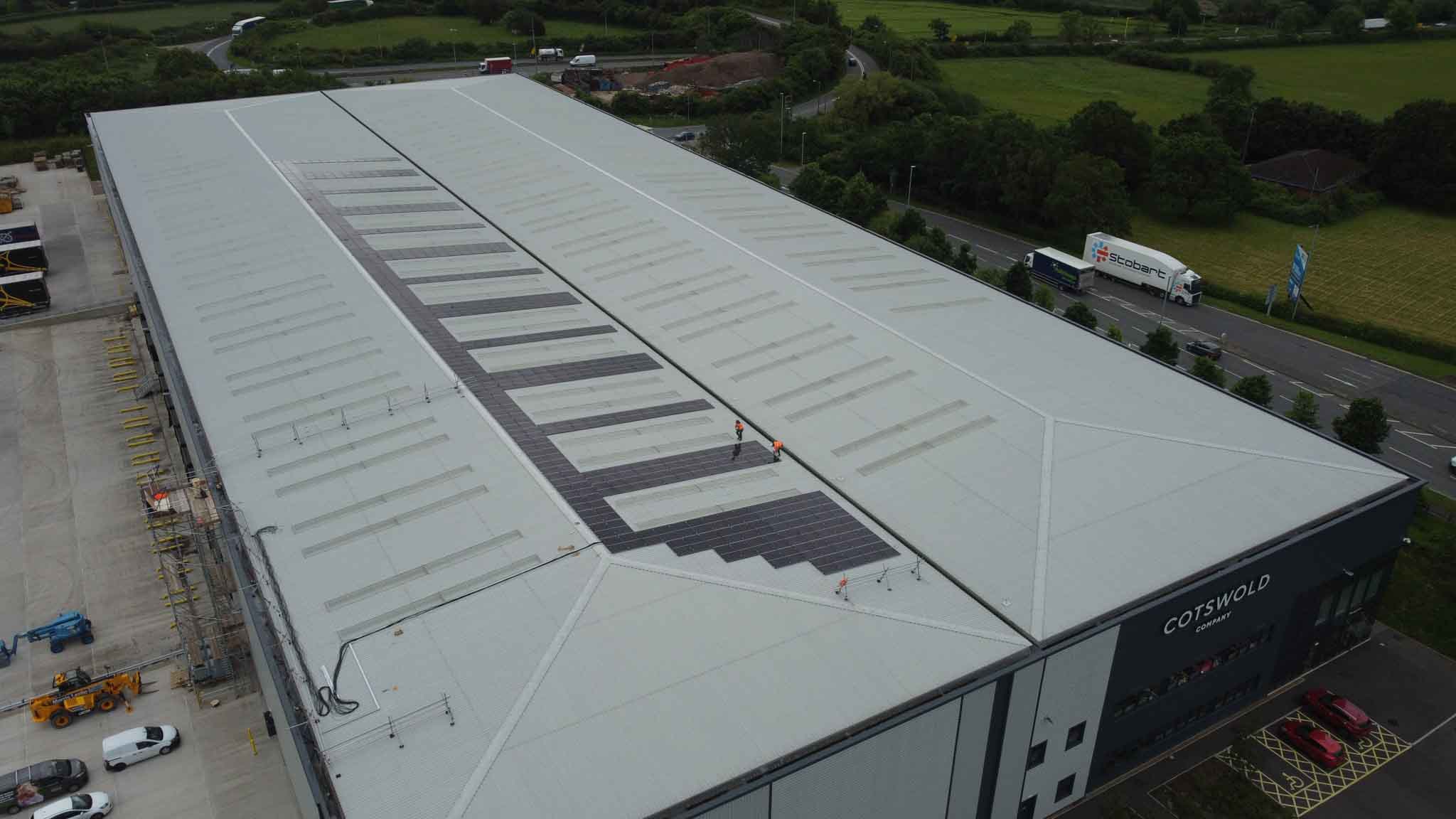
When grid capacity is readily available, and planning restrictions are minimal, a commercial solar project can move quickly from initial query to clean energy generation.
After the initial survey and proposal approval, here’s the average timeline of events if all goes according to plan:
| Project Phase | Typical Duration | Key Activities & Deliverables |
|---|---|---|
| Week 1: Technical Site Survey (Pre-Installation Survey) | 1 Week | On-site physical survey, structural roof assessment, electrical capacity checks, and access/mounting evaluations. |
| Week 2–3: Grid Application (Fast-Track) | 2 Weeks | Formal DNO application submittal; preliminary approvals under standard limits or pre-cleared connections. Tech designs will be signed off during this stage. |
| Week 4–5: Procurement & Site Prep | 2 Weeks | Ordering hardware (modules, inverters, mounting kits), erecting safety scaffolding, and finalising access routes. |
| Week 6–7: On-Site Installation | 1–2 Weeks | Roof mounting, DC/AC wiring, inverter installation, and safety integrations. |
| Week 8: Commissioning & Handover | 1 Week | System testing, regulatory compliance sign-off, grid connection authorisation, and client handover. |
Disclaimer:
Please note that the 6- to 8-week timeline serves as an ideal baseline for standard rooftop commercial solar installations with a system size up to 100 kWp. Project scope and physical installation requirements directly impact delivery schedules:
- System Scale: Larger installations (exceeding 100 kWp) naturally require longer design, procurement, and construction phases.
- Grid Connections: DNO grid applications and approvals are significantly faster and more straightforward for smaller capacity connections.
- Mounting Infrastructure: This timeline specifically reflects standard commercial roof-mounted arrays. Ground-mounted solar installations involve civil works, trenching, structural foundations, and planning approvals that will extend the overall project duration.
Factors That Can Prolong the Process
While a fast turnaround is achievable, several critical external factors can extend a project timeline to several months, or even over a year:
Distribution Network Operator (DNO) Approvals
Connecting business solar panels to the national electricity grid requires formal authorisation from the local Distribution Network Operator (e.g., National Grid Electricity Distribution, UK Power Networks, Northern Powergrid).
G98 Applications: For small systems (typically under 16A per phase), post-installation notification is often sufficient.
G99 Applications: Commercial arrays exceeding standard thresholds require prior formal approval. If the local grid node is congested, the DNO may require network reinforcement studies or infrastructure upgrades, which can add 8 to 26 weeks (or longer) to the timeline.
Chloe Regenaz, Head of Planning & Applications, on DNO Approvals:
“While G98 applications allow post-installation notification for systems under 16A per phase (up to 11kW on a standard three-phase supply), the vast majority of commercial solar installations exceed this capacity and will require a formal G99 application and prior DNO approval before connection.”
Planning Permission Restrictions: Many commercial buildings qualify for Permitted Development Rights (PDR) for rooftop solar. However, full planning permission or prior approval is required if:
- The building is, or is within the curtilage of, a Grade I or Grade II listed property, or a Scheduled Monument.
- The solar equipment would be installed within 1m of the external edge of the roof or wall.
- Solar arrays protrude more than 200mm from the roof plane (on pitched roofs) or exceed specified height limits on flat roofs.
- Certain installations within a Conservation Area, Area of Outstanding Natural Beauty (AONB), or National Park apply, such as flat-roof solar installations in a Conservation Area, which require Prior Approval.
Obtaining formal planning approval typically adds 8 to 12 weeks to the project lead time.
Structural Integrity & Roof Upgrades
Commercial roofs must safely support the weight of PV arrays and wind-load pressures. If a structural survey indicates that reinforcement work, re-roofing, or asbestos remediation is necessary before mounting can begin, overall project timelines will shift accordingly.
How Businesses Can Streamline Their Solar Installation
To prevent unnecessary delays and ensure an efficient rollout, organisations should adopt proactive preparation strategies:
1. Finalise Project Funding Early
Securing capital expenditure approval, arranging green commercial loans, or finalising Asset Finance/Power Purchase Agreements (PPAs) prior to engaging an installer avoids delays during procurement and scheduling.
For more information on PPAs, visit our dedicated article by clicking here.
And for further details on Asset Financing, visit our blog here.
2. Gather Electrical & Consumption Data Proactively
Providing your installer with 12 to 24 months of half-hourly electricity usage data (HH data), building floor plans, and current electrical schematics significantly accelerates initial design and sizing.
3. Establish Internal Governance & Approvals
Appointing a dedicated project sponsor to streamline internal sign-offs, such as landlord approvals, leaseholder consents, and safety clearances, prevents administrative hold-ups during critical path phases.
Accelerating the Transition to Commercial Solar
Investing in commercial solar offers substantial long-term protection against energy price volatility and significantly reduces corporate carbon emissions.
While complex grid upgrades or planning requirements can extend lead times for larger infrastructure projects, many businesses can achieve full installation within 6 to 8 weeks through structured planning and early administrative preparation.
If you’re interested in solar panels for your business, visit our parent page for more information on how Geo Green Power can support your transition to renewable energy.
For more general enquiries, contact our team today.