Navigating Grid Connections: G98, G99 & G100 Explained for Commercial Solar & Battery Storage
For UK commercial enterprises investing in rooftop solar PV, ground-mounted arrays, or commercial battery energy storage systems (BESS), navigating grid compliance is a vital milestone in project delivery.
Connecting generation equipment to the UK electricity distribution network requires compliance with specific standards governed by the Distribution Network Operators (DNOs). Three regulations lie at the heart of this process: Engineering Recommendation (ENA EREC) G98, G99, and G100.
Understanding these regulations, and how they impact project timelines, capital expenditure, and system capability, is crucial for commercial energy managers, facility directors, and commercial developers.
What is the Distribution Network Operator (DNO)?
Before examining the specific regulations, it is essential to understand the authority overseeing grid connections.
Your Distribution Network Operator (DNO) is the licensed company responsible for maintaining and operating the physical electricity infrastructure, cables, transformers, and substations, in your region. Unlike your energy supplier (who bills you for electricity usage), the DNO owns and manages the regional grid infrastructure (such as National Grid Electricity Distribution, SP Energy Networks, UK Power Networks, Northern Powergrid, Electricity Northwest, or Scottish and Southern Electricity Networks).
In Nottingham, where we are based, National Grid Electricity Distribution is the local Distribution Network Operator (DNO).
When a commercial facility generates its own electricity via solar PV or discharges a commercial battery into its internal network, it operates in parallel with the national grid. This can influence local voltage stability, fault levels, and power quality.
Consequently, the local DNO must regulate how much generation and storage capacity is connected to its infrastructure.
G98: Small-Scale Microgeneration (Domestic vs Commercial Context)
What is G98?
Engineering Recommendation G98 applies to small-scale, fully type-tested microgeneration installations. It is defined by a strict output limit:
- Single-Phase Systems: Up to 16 Amps per phase (3.68kW).
- Three-Phase Systems: Up to 16 Amps per phase across three phases (11.04kW).
Why G98 Rarely Applies to Commercial Projects
For residential settings, 3.68kW or 11.04kW system limits are common. However, for commercial enterprises, a system under 11.04kW is usually insufficient to cover typical operational baseloads.
Most commercial solar installations range from 30kWp to over 1MWp, exceeding G98 limits.
The main advantage of G98 is its “Fit and Inform” process: In the majority of cases, installers can fit the equipment and simply notify the DNO within 28 days of commissioning without requiring prior approval.
Key Takeaway for Business Owners & Property Managers: Unless your business operates out of a very small office or light commercial unit requiring a minor rooftop installation under 11.04kW three-phase, G98 will rarely apply to your project.
G99: The Standard for Commercial Generation & Battery Storage
What is G99?
Engineering Recommendation G99 covers all electricity generation equipment operating in parallel with the distribution network that falls outside or exceeds the G98 threshold.
For virtually all commercial solar PV arrays, combined solar-plus-storage projects, and standalone commercial battery installations, G99 is the standard connection route.
The “Apply Before Install” Rule
Unlike G98, a standard G99 connection operates on an “Apply to Connect” basis. You cannot install or energise a G99-scale system until the DNO has completed a technical assessment of your local network, granted formal approval, and issued a formal Connection Offer.
During a G99 assessment, the DNO analyses key network metrics:
- Thermal Capacity: Can local network cables and transformers handle the potential reverse power flow?
- Voltage Rise: Will export drive local grid voltages beyond statutory limits?
- Fault Level Impact: Does the inverter-based generation increase potential fault currents beyond safety margins?
G99 Fast Track (SGI Routes)
For mid-sized commercial projects or installations combining existing solar with a new battery, the Small Generation Installation (SGI) fast-track routes under G99 may apply (such as SGI 1, 2, or 3). If the proposed system meets specific capacity criteria, typically with an Intrinsic Design Capacity under 32A per phase or Aggregate Registered Capacity under 60A per phase using pre-approved, type-tested inverters, the DNO approval process can be significantly accelerated.
G100: Export Limitation Schemes
What is G100?
Engineering Recommendation G100 specifies the technical requirements for Export Limitation Schemes (ELS).
In many commercial areas, the local network lacks the thermal or voltage capacity to accept full export from a large solar array or high-power battery storage system during peak production hours.
Rather than forcing the business to pay for expensive grid reinforcement (such as upgraded transformers or cables) or downsize the solar PV array, a G100 Export Limitation Scheme can be implemented.
How G100 Works in Practice
A G100-compliant scheme uses power meters, active controllers, and fail-safe algorithms to monitor grid export at the boundary meter in real time.
- Example Scenario: A manufacturing facility installs a 500kWp solar array, but the DNO caps grid export at 100kW due to local grid constraints.
- Under normal operations, if site energy demand drops to 50kW, the solar array attempts to export 450kW.
- The G100 controller detects this excess, within seconds modulating the inverter output or directing the excess power into an on-site commercial battery storage system, ensuring export never exceeds the agreed 100kW limit.
Key G100 Requirements
- Fail-Safe Operation: If communication between the central meter and the inverter or battery controller fails, the system must automatically curtail generation or export to the pre-agreed safe limit within a specified timeframe (typically under 5 seconds).
- Type Testing & Approval: Equipment used for export control must meet strict G100 standards and be accepted by the DNO.
Summary Comparison: G98 vs G99 vs G100
| Metric / Feature | EREC G98 | EREC G99 | EREC G100 |
|---|---|---|---|
| Primary Scope | Microgeneration up to 16A/phase | Commercial & large-scale generation (>16A/phase) | Export Limitation Schemes (ELS) |
| Capacity Threshold | ≤ 3.68 kW (1-Phase) / ≤ 11.04 kW (3-Phase) | > 11.04 kW (3-Phase) up to multi-MW | Governs export limits on G98/G99 installations |
| Application Process | Fit and Inform (Notify within 28 days post-commissioning) | Apply to Connect (DNO approval required prior to installation) | Submitted alongside G99 application if export capping is required |
| Target Sector | Residential / Very small commercial | Commercial, Industrial, Agricultural & Utilities | Commercial & Industrial sites with grid export constraints |
| Battery BESS Inclusion | Inverters/batteries capped under 16A total per phase | Must include inverter + BESS power combined | Controls BESS export dynamically to stay under network limits |
| Lead Times | Immediate installation permitted | 4 to 12+ weeks depending on network complexity | Evaluated concurrently with the G99 connection request |
The Role of Commercial Battery Energy Storage (BESS)
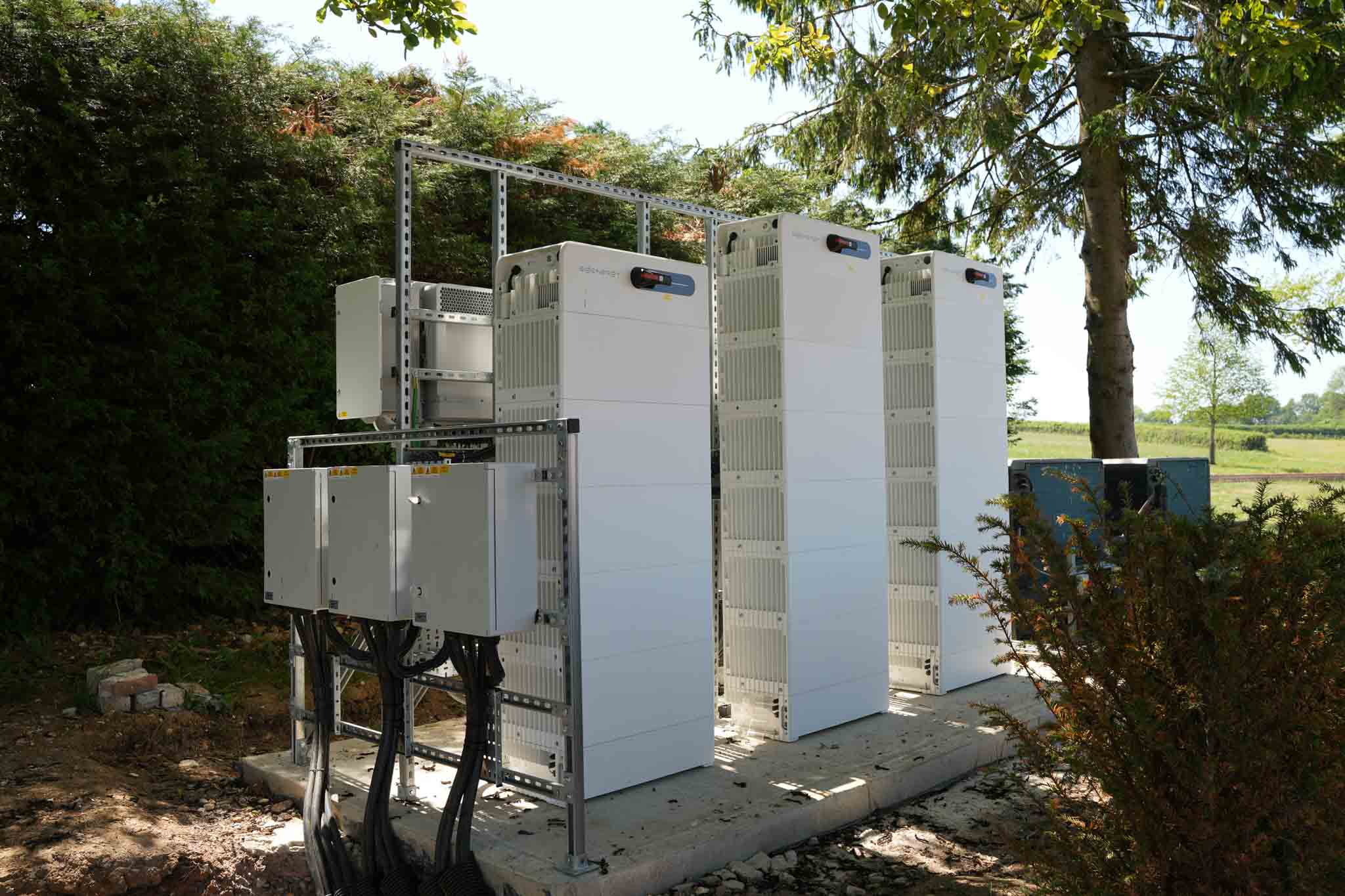
Adding commercial battery storage fundamentally changes how G99 and G100 applications are calculated.
Combined Registered Capacity
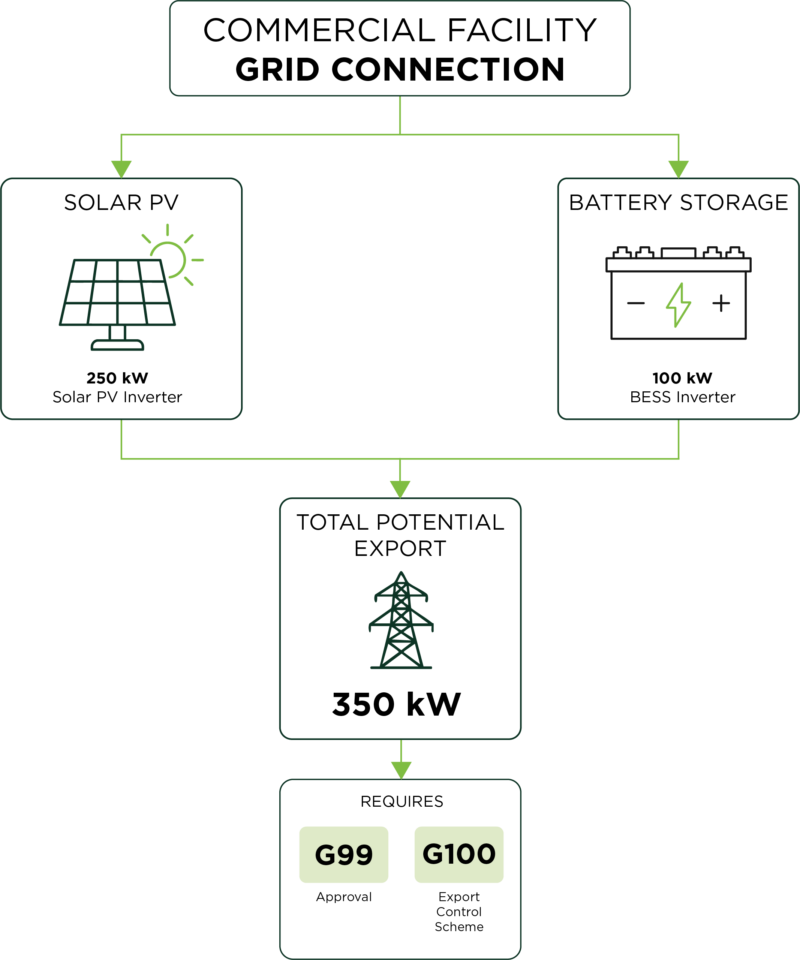
When assessing a G99 application, DNOs do not evaluate solar PV panels alone; they evaluate the total potential export from all inverters.
If a commercial site has a 250kW Solar PV inverter and installs a 100kW Battery Inverter, the total aggregate generation capacity is assessed as 350kW.
Even if the commercial battery is intended solely to charge from the solar panels and discharge during peak evening tariff hours, the DNO considers its theoretical capability to discharge into the grid simultaneously with peak solar generation.
(See Below).
Unlocking Constrained Sites with Battery Storage & G100
For businesses operating in grid-constrained areas where the DNO limits export to a fraction of total solar capacity, combining G99 approval with G100 export limitation and BESS offers a powerful solution:
- Avoid Curtailment: Instead of throttling solar generation when site demand drops and grid export limits are reached, excess solar energy is diverted directly into the battery BESS.
- Peak Shaving & Load Management: Stored energy can be discharged during peak tariff windows (such as DUoS red zones or high-tariff periods) to reduce grid import costs.
- Revenue Generation: A G99-approved battery can participate in grid stability mechanisms (such as Dynamic Containment or Firm Frequency Response) when local network conditions permit.
Commercial Implementation Checklist for Energy Managers
To keep your commercial renewable project on schedule and within budget, consider the following key milestones:
- Early DNO Engagement: Submit your G99 application as early as possible in the feasibility phase. DNO responses can take anywhere from 4 to 12 weeks (or longer if complex network studies or reinforcements are needed).
- Review Existing Generation: Ensure any existing solar PV arrays or backup generators are fully documented on your G99 application. DNOs evaluate aggregate capacity across the entire site meter (MPAN).
- Factor G100 into Hardware Specification: If your site requires export control, ensure selected commercial solar inverters and battery management systems are G100-compliant and certified.
- Complete Post-Commissioning Records: Once installation is complete, your installer must submit G99 commissioning forms to the DNO within 28 days to secure formal connection approval.
- Secure Your Export Tariff: Smart Export Guarantee (SEG) or Power Purchase Agreement (PPA) providers require verified DNO connection documentation before setting up export payments.
For more information regarding Smart Export Guarantee (SEG), read our dedicated guide.
Read our PPA guide for more information.
Who Is Responsible for the DNO Application?
While the legal responsibility for ensuring a site complies with grid connection regulations ultimately sits with the electricity bill payer (the site owner or tenant), navigating the G99 and G100 application process is a highly technical task.
An Experienced Installer Handles the Heavy Lifting
A reputable commercial solar and battery installer will manage the entire DNO process on your behalf as a core part of their service. Rather than leaving energy managers to deal with complex network paperwork, your installation partner will:
- Manage the Application End-to-End: Complete and submit the initial G99 application, prepare single-line diagrams (SLDs), and liaise directly with your local DNO during the technical assessment phase.
- Coordinate with Off-Takers & Suppliers: Work alongside your energy supplier or Power Purchase Agreement (PPA) off-taker to ensure all boundary meters, export MPANs, and metering arrangements align smoothly with grid approvals.
- Integrate G100 Controls: Specify and configure certified hardware that meets the DNO’s exact export limitation conditions.
- Secure Post-Commissioning Sign-Off: Complete all required G99 commissioning tests on site and submit the final documentation to the DNO to obtain your official Letter of Acceptance, the vital document needed to unlock export tariffs or PPA payments.
By partnering with an experienced turn-key commercial installer, your business can avoid costly regulatory delays, prevent accidental grid non-compliance, and ensure your system is approved and energised on schedule.
Summary
G98 is a simple post-installation notification route reserved for microgeneration under 11.04kW three-phase, rarely suited for commercial energy demands.
G99 is the standard, mandatory “apply before install” process for commercial solar PV and battery storage systems exceeding 11.04kW.
G100 provides the framework for smart export limitation, enabling businesses to install large-scale solar and battery systems even on grid-constrained sites without incurring massive grid upgrade costs.
By partnering with an experienced commercial installer, your business can navigate G99 and G100 approvals smoothly, ensuring compliant grid integration, optimal system sizing, and maximised return on investment.
To learn more about solar panels for businesses, visit our parent page.
And for commercial solar battery storage systems, visit our service page.